

The Maryland annual report is the filing that keeps a charter in force, and it combines two obligations that other states split apart. Form 1 carries the business entity report and the business personal property return in one document, and every corporation, limited liability company, partnership, and trust on the register files it. The State Department of Assessments and Taxation processes the form, and the deadline is the same for every entity regardless of when it was formed.
This page covers the form itself, the entities that must file, the April date, the fee that accompanies the report, the consequence of a missed filing, and the route back to good standing. It is written for owners filing their own report, bookkeepers preparing a client’s file, and buyers who need to read a company’s compliance history before a deal.
How to File a Maryland Annual Report
The report is filed through Maryland Business Express, and the portal pre-fills the entity details from the prior year. The filer confirms the name, the Department ID, the principal office, and the resident agent, completes the personal property schedule, and pays the fee. A reader who needs the entity record before filing can begin at Maryland Annual Report on the home page and confirm the class. The department accepts the form, posts the receipt, and the status on the public record stays active for another year.
Online Filing
An online filing is the faster route and the one the department prefers. The portal validates the Department ID, shows the amount due, and accepts a card payment with a processing percentage added at checkout. The confirmation page appears at the end of the session, and the receipt stays in the account history. A filer who needs a copy later can download it from the same account.
Paper Filing
A paper Form 1 is mailed to the Business Services Unit in Baltimore, and the department accepts it with a check or a money order. The paper route takes longer and carries no card charge. A filer who posts the form close to the deadline should use a trackable delivery method, because the department records the date it receives the document rather than the date it was mailed. Keep the postal receipt with the company’s tax file.
Confirmation and Receipts
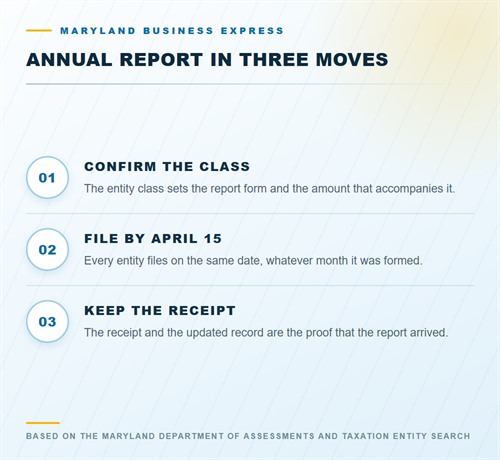
The receipt is the proof that the report arrived, and it matters when the status later comes into question. The department posts the filing to the entity record, and the record then shows the report date beside the earlier entries. A filer who pays but does not see the record update within a few business days should check the account for a hold. A held report is not a filed report, even when the card was charged.
Form 1 filing:
https://dat.maryland.gov/
Form 1 and the Personal Property Return
Form 1 is a combined document, and the combination is the part that surprises new owners. The annual report section confirms the entity’s identity and addresses, while the personal property section reports the tangible property the business holds in Maryland. The department uses the property schedule to value the business for county assessment, which is why the form asks for equipment, furniture, and inventory rather than revenue.
One Filing, Two Purposes
The two sections travel together, and the department will not accept one without the other for a business entity. A company that files the report but leaves the property schedule blank can expect a notice and a corrected filing. A company with no Maryland property still completes the schedule and reports zero, because the absence of property is itself a fact the form records. The single submission keeps the charter and the assessment file in line.
Who Completes the Property Schedule
The owner or an accountant prepares the schedule from the depreciation records and the year-end fixed asset list. A business that leases equipment reports the leasehold improvements it owns rather than the equipment itself. A home-based service company with a desk and a laptop still reports the furniture and the equipment it uses in the business. The schedule is a valuation document, and an understatement can produce a later assessment with interest.
Which Entities Must File
Every legal entity formed, qualified, or registered in Maryland files an annual report, and the obligation does not depend on activity. A company that earned nothing, owns nothing, and conducted no business during the year still files. The department’s rule is tied to the charter rather than to the revenue, and a dormant entity that skips the form loses its standing in the same way as an active one.
Corporations and LLCs
A stock corporation files Form 1 and reports its shares in the entity section. A limited liability company files the same form and reports its principal office and agent. A limited partnership and a limited liability partnership also file, and each carries the standard fee. The entity type changes how the form is completed in places, but it does not change the deadline or the consequence of a missed filing.
Nonstock and Exempt Classes
A nonstock corporation files the report but pays no fee, which is a distinction that catches filers who assume the form is optional. A foreign corporation that holds an interstate registration also files without a fee. A family farm that the department has certified pays a reduced amount. The form still has to arrive by the deadline in each of those cases, because the fee waiver does not waive the filing.
Foreign Entities
A foreign entity registered to do business in Maryland files the same report as a domestic one. The registration date does not change the April deadline, and the home-state charter does not excuse the Maryland filing. A foreign entity that stops doing business in the state should withdraw its registration rather than let the reports lapse, because a forfeited foreign record can complicate a later re-entry.
The April 15 Deadline
The due date is April 15 for every entity on the register, and Maryland does not stagger the date by formation month. A company formed in November files the following April along with a company formed a decade earlier. The department opens the portal for the filing season well before the date, and the form can be submitted early in January. An early submission removes the risk of a queue in the final week. A filing that arrives after the date is treated as late even when the delay is a single day.
Fixed Date for Every Entity
A single date simplifies the calendar for a business with several entities, because every report falls due at once. It also concentrates the department’s workload, and the portal slows in the final week. A bookkeeper who manages several clients should file the simple reports first and leave the property schedules for later in the season. Filing in March avoids the queue without any penalty.
First-Year Filings
A newly formed entity files its first report in the April that follows formation, even when the charter was issued in December. The fee is not prorated for a partial year. A founder who budgets for the formation fee alone can be surprised by the report charge four months later. Put the April date on the company calendar at the moment the charter is accepted.
The Filing Fee
The report carries a state fee that the department publishes on the form and on the portal, and the amount depends on the entity class rather than on revenue. The fee accompanies the report, and the department will not accept the filing without it. A payment that fails or a check that bounces leaves the report unfiled, even when the form itself was complete.
Standard Amount
A stock corporation, an LLC, a limited partnership, a limited liability partnership, a business trust, and a real estate investment trust each pay the standard amount shown in the table below. The fee applies to a domestic entity and to a registered foreign entity alike. A company with several entities pays the amount for each one, because the charge attaches to the charter rather than to the owner.
Waivers and Reduced Amounts
A nonstock corporation pays nothing, and a foreign corporation with an interstate registration also pays nothing. A certified family farm pays a reduced amount set by the department. A business that participates in the state’s retirement savings program may qualify for a waiver when it provides the required evidence. The waiver applies to the fee, not to the obligation, and the report still has to arrive on time.
Filing the Report in Order
The form is short enough to complete in one sitting when the records are at hand, and the order of the sections matters less than the accuracy of each field. The identity section comes first, then the addresses and the agent, then the property schedule, then the payment. A filer who works through the form in that sequence catches a stale address before the payment screen appears.
A calendar reminder in early March gives the filer time to collect the depreciation schedule and to confirm the agent is still serving. The portal saves a partially completed form, so the work can be spread across a week without losing the entries. A business with several entities should file them in one session, because the account keeps the receipts together and the confirmation emails arrive in sequence.
What the Form Asks
The form asks for the business name, its identifier, the class, the two addresses, the agent, and the officers or members the department lists. The property section asks for cost and depreciation figures by category. A signature from an authorized person closes the form, and the online version replaces the signature with an account authentication.
Frequent Errors
The errors that return a report are usually mechanical: an old address, an agent who resigned, a property schedule that totals incorrectly, or a payment that did not clear. A report filed under the wrong Department ID can land on another entity’s record, which takes longer to correct than a resubmission. Check the identifier on the confirmation screen against the charter before closing the session.
After the Report Posts
The department posts the report to the entity record, and the status remains active when the filing and the payment clear. The record shows the report date, and the filing history adds an entry beside the earlier years. A counterparty reading the record can see that the entity has kept up its filings, which is the practical value of the report beyond the legal requirement.
Status Update
The status field stays active, and a later forfeiture would change it, so the record is a live indicator rather than a permanent certificate. A company that files on time but later misses a payment can still be forfeited, because the status follows the account rather than the last report. Check the record after the filing season closes, not only on the day the report is submitted.
Records to Keep
Keep the confirmation page, the payment receipt, and a copy of the filed form with the company’s tax records. A bank or a buyer may ask for the last two receipts, and the portal history is easier to search when the dates are known. A company that changes accountants should hand over the receipts with the rest of the compliance file. The certificate of good standing page covers the document that shows the standing a filed report protects.
Report and Certificate
The report keeps the status active, and the certificate proves the status to a third party. The two documents answer different questions and neither replaces the other: a receipt shows that the report was filed, while a certificate shows the standing on a chosen date. A bank that asks for proof of standing wants the certificate, and a buyer reviewing the file wants the receipts. Keep both in the same folder so the pair is easy to produce.
Missing the Deadline
A report that does not arrive by April 15 puts the charter at risk, and the department moves the entity to forfeited status after the grace period. A forfeited business may still own property and carry debt, yet it lacks authority to trade in the state or to sue on its agreements. The status appears on the public record, and a counterparty who checks before signing will see it.
Forfeiture
Forfeiture is automatic once the department closes the account, and it does not require a court order. A forfeited entity that continues to operate is doing so without authority, and its contracts may be hard to enforce. A bank may freeze an account when it discovers the status, and a landlord may treat the lease as breached. The label is public, so the consequence usually arrives before the company expects it.
Reinstatement Cost
The department wants every skipped report, the money owed on each, and a revival document with a separate charge. Once the account clears, the charter returns, and the history keeps both the forfeiture and the revival. A company that missed several years pays for each one, which is why a short lapse is cheaper to correct than a long one. The Maryland business registration page covers the filings that follow revival.
Correcting a Filed Report
A report that was filed with an error can be corrected, and the department accepts an amended return for the year in question. The correction matters when the error touches the property schedule, because the assessed value flows from those figures. An address or agent error is usually corrected through a separate notice rather than an amended report. The department does not refund a fee because the form was wrong.
Amended Return
An amended return restates the figures for the year and describes the change. The department reviews it and adjusts the assessment when the correction is accepted. A company that discovers an understatement should file the amendment before the department issues a notice, because the penalty is lower when the correction comes from the filer. Keep the original receipt with the amendment so the file shows both versions.
When to File Again
A report that was never received is refiled rather than amended, and the filer should confirm with the department that the first submission did not post. A duplicate payment is refundable on request, but the request takes time. A report filed for the wrong entity is corrected on the right record and the wrong one is amended to zero. Each of those routes starts with a call or a portal message rather than a second payment.
Annual Report Fees
The department publishes the report fee for each entity class, and the amounts below cover the filings a business is most likely to encounter. The fee accompanies the report, and a report without payment is not accepted. Expedited handling applies to some charter filings but not to the annual report itself.
| Entity class | Report fee |
|---|---|
| Stock corporation, domestic or foreign | $300 |
| Limited liability company, domestic or foreign | $300 |
| Limited partnership or limited liability partnership | $300 |
| Business trust, real estate investment trust | $300 |
| Certified family farm | $100 |
| Nonstock corporation | $0 |
| Foreign interstate corporation | $0 |
| Articles of reinstatement after forfeiture | $100 plus missing reports |
Frequently Asked Questions
Owners, bookkeepers, and buyers reading a compliance file asked the following. The answers point to the form or the office involved.
Does a dormant company file an annual report?
Yes. The obligation follows the charter, not the activity, so a company with no revenue and no property still files and pays. A dormant entity that skips the form loses its standing like any other.
What is the personal property return?
It is the section of Form 1 that reports the tangible property the business holds in Maryland, and the department uses it for the county assessment. A company with no property reports zero rather than leaving the section blank.
What happens if the report is one day late?
The filing is treated as late once the date passes. The department may allow a short grace period before forfeiture, but the safe assumption is that the deadline is firm and that a late report puts the charter at risk.
Can the fee be waived?
Some classes pay nothing and a participating business may qualify for a waiver. The waiver applies to the fee, and the report still has to be filed on time. Check the class on the form before assuming a waiver.
How do I prove the report was filed?
The portal receipt and the updated entity record are the proof. Keep both with the tax file, and order a certificate of status when a counterparty needs a dated document with a seal. The receipt carries the date the department accepted the form.