

Maryland corporation search begins with the entity index on Maryland Business Express and ends with a reading of the corporate charter. The State Department of Assessments and Taxation holds the record, and the Corporation Charter Division processes the documents that create, amend, and end a corporation. A lookup returns the legal name, the Department ID, the class of corporation, the status, the principal office, the resident agent, and the filings that have been accepted into the file.
This page covers the corporate side of the register: the two corporation classes, the articles that form the entity, the share data the state collects, the reports that keep the charter alive, and the filings that change it. It serves buyers reviewing a supplier, attorneys checking a predecessor, officers confirming their own filing, and lenders who need a dated statement of standing.
How to Search Maryland Corporation Records
The search page offers a name field, a Department ID field, and a federal employer number field, and the corporate record opens from any of the three. Start with the name when the company is known only by its trade style. A reader who wants the wider index can begin at Maryland Corporation Search and switch between classes there. Use the Department ID when a receipt, a contract, or an old report supplies the state number. The federal number helps when the corporation trades under a name that differs from the charter.
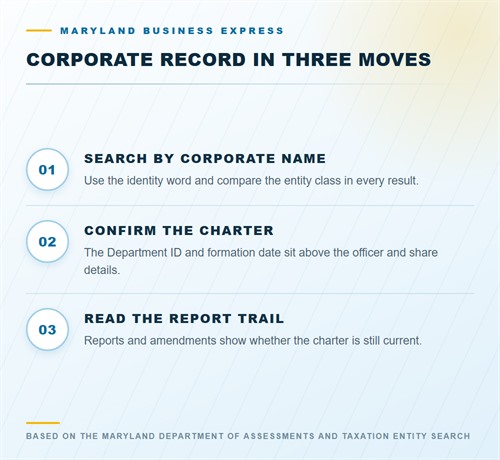
Search by Corporate Name
Type the distinctive word and leave the ending for a second attempt. A query for “Severn” returns every corporation, company, and limited partnership that carries that word, which is exactly the list needed to spot a near match. Maryland compares filed names after the designation is set aside, so a search that includes Inc. or Corp. can hide a record filed as Limited. Open the results by Department ID rather than by position in the list.
Search by Department ID
The Department ID is assigned when the articles are accepted and it never changes, even when the name does. A domestic stock corporation carries a D prefix and a foreign corporation carries an F, which lets a reader tell the two apart before the record loads. Copy the identifier from a certificate or a report receipt, because an invented number returns no result and can be mistaken for a missing record.
Reading the Results List
Each result shows the name, the Department ID, the entity type, and the status. A long list usually means the query word is broad, not that the company has many affiliates. Sort by status first, then by formation date, and open the record whose principal office or resident agent matches the business in front of you. A dissolved corporation with a similar name is easy to confuse with an active one, and the status column is the fastest way to separate them.
Documents Held Outside the Charter File
Not every corporate document is published in the entity index. Internal records such as bylaws, minutes, and the stock ledger stay with the corporation, and a buyer who needs them has to ask for them in diligence. The charter file holds the articles, amendments, mergers, and reports, and it is the only part the department can certify. Knowing which pile a document belongs to prevents a wasted search and a wasted records request.
SDAT entity index:
https://egov.maryland.gov/BusinessExpress/EntitySearch
What a Corporate Record Shows
A corporate record is built from charter documents rather than from a business profile. It states what the corporation filed, when the department accepted each document, and which addresses and agents the corporation declared. It does not list customers, revenue, lawsuits, or credit history. The record answers whether the corporation exists, who accepts service for it, and what it has filed, and those three answers carry most of the weight in a routine check.
Domestic and Foreign Corporations
A domestic corporation is formed under Maryland law by filing articles with the department. A foreign corporation is formed in another state or country and then registers to do business in Maryland. Both appear in the same index with different prefixes, and both file an annual report. The foreign record shows the home jurisdiction as well as the Maryland registration date, and the two dates rarely match.
Stock and Nonstock Classes
A stock corporation issues shares and states the number and par value in its articles. A nonstock corporation has no shares, and the class covers charities, religious bodies, and membership organizations. The distinction drives the organization and capitalization fee at formation and the annual report fee afterward. A nonstock corporation also follows a different path when it seeks federal tax exemption, which the state filing does not grant.
The Articles of Incorporation
The articles are the document that creates the corporation, and every later filing refers back to them. Maryland requires the incorporator to name the corporation, describe its purpose, give a Maryland street address for the principal office, name a resident agent, and state the share structure or the absence of shares. The initial directors are named in the articles, and the resident agent signs the document along with the incorporators.
What the Articles Must State
The corporate name must carry a recognized ending such as Corporation, Incorporated, or Limited. The purpose can be a sentence or two, and a general business purpose is acceptable for most filers. The principal office must be a physical Maryland address rather than a post office box, and the resident agent must be a Maryland resident or a Maryland entity with a street address in the state. A missing signature from the agent is a frequent cause of rejection.
Organization and Capitalization
A stock corporation pays the filing fee plus an organization and capitalization fee that follows the aggregate par value of its authorized shares. A simple structure with a modest share count falls at the minimum. A large authorized capital or a no-par structure with many shares moves the charge upward, and the department calculates the amount on request. The fee is assessed at formation and again when the corporation increases its authorized capital.
Department ID, Dates, and Filings
The identifiers and dates on a corporate record form a timeline, and the timeline is often more useful than any single field. The formation date marks the start, the report dates show compliance, and the amendment dates show what changed. A reader who follows the timeline can see whether a name, an address, or an agent changed before or after a contract was signed, which is the question that matters in a dispute.
Prefix Letters and Processing Dates
The D or F prefix identifies the class, and the digits that follow are assigned in sequence. The date beside a document is the day the department processed it, not the day it was signed or mailed. A filing delivered on the last day of a month can post in the next one, and an expedited submission moves ahead in the queue without changing the order of the dates. Compare the acknowledgment date with the record date when a filing seems late.
The Filing History
The history lists articles, amendments, mergers, report receipts, agent changes, and closures in the order they were recorded. Each entry carries a document type and a date, and the list is short for a young corporation and long for one that has changed hands. A missing entry is not proof that nothing was filed, because some documents are not recorded in the public view. Use the history to locate the document you need, then order a certified copy if the exact text matters.
Officers, Directors, and Shares
Maryland collects governance data through the articles and the annual report, and the public record exposes part of it. The articles name the initial directors, and later reports restate the current directors and officers. Share data appears at formation and whenever the authorized capital changes. The register does not publish a shareholder ledger, so the identity of the owners is usually absent from the public file even when the share count is visible.
For a small corporation the three lists overlap, and the same person can appear as incorporator, director, officer, and sole shareholder. For a larger one the lists separate, and the record then shows a board that differs from the management team. Read the titles as the corporation reported them, and check the report date, because a director who resigned last month can still appear until the next filing posts.
Director and Officer Fields
The director and officer fields identify the people who run the corporation, not the people who own it. A change of officers is an internal matter unless the corporation files an amendment or a report that restates the list. When a contract is signed by an officer, confirm that the person holds the title the corporation claims, and confirm the corporation’s status on the day of signing. A title on letterhead is not evidence of authority.
What Share Data Is Public
The articles state the number of authorized shares and the par value, and those figures stay on the record. The number of issued shares and the identity of the holders are not part of the public index. Anyone who needs the ownership list must ask the corporation, a stock ledger, or a signed representation in the purchase agreement. The state record confirms the structure, not the holders.
Corporate Status and Forfeiture
An active corporation is current on its reports and its charter stands. A corporation that misses the annual report or fails to pay the amount due loses its charter rights through forfeiture. The status field reports the result, and the filing history shows the last report that posted before the change. Forfeiture does not erase the entity, and it does not erase the debts, but it does suspend the right to do business and the right to sue on contracts.
Active and Forfeited
An active record supports a routine vendor check without further documents. A forfeited record calls for a conversation before any payment or contract. The corporation can still hold assets and owe money, and a counterparty that signs with a forfeited entity may find the agreement hard to enforce. Ask for the current report receipt or a certificate of status before proceeding, and compare the date on the certificate with the date of the deal.
Revival After Forfeiture
Revival needs the unfiled reports, the charges for each, and a revival document billed separately. The department restores the charter when the balance clears, and the record then shows the revival date along with the earlier forfeiture. The gap stays visible, which is useful for a reader who wants to know whether the corporation was in good standing during a past transaction. The certificate of good standing page sets out the paperwork that confirms the restored status.
Amendments, Mergers, and Dissolution
Corporate records change through filings, and each filing leaves a trace. An amendment alters a name, an address, an agent, or the share structure. A merger combines two corporations into a successor, and a dissolution ends the charter. The index keeps the older documents alongside the newer ones, so a reader can follow the sequence rather than guess at it. The current fields show the present state, and the history shows how the corporation arrived there.
Each of those filings has a different effect on the charter. An amendment leaves the corporation in place with new terms, a merger ends the separate existence of the merging parties, and a dissolution closes the file after the assets are distributed. A correction fixes a clerical error without changing the underlying decision. When a record shows several filings in a short span, read them in order before drawing a conclusion about the current ownership or address.
Name and Address Changes
A name change is filed as an amendment and takes effect when the department accepts it. The old name stays in the history, and the new name becomes the one that appears in a search. An address change follows the same route, and a resident agent change uses a shorter notice with its own fee. When a contract or a license still carries the former name, match the amendment to the live record before changing the file.
Successor Records
A merger creates a successor corporation and ends the separate existence of the merging entities. The successor record carries the combined charter, and the earlier records show the merger as their final entry. A contract signed by a corporation that later merged binds the successor, which is why a buyer traces the chain rather than stopping at a dissolved result. A certified copy of the merger document is the evidence that ties the two records together.
Foreign Corporations in Maryland
A corporation formed in another state registers in Maryland before it conducts intrastate business. The registration requires a certificate of good standing from the home jurisdiction, a Maryland principal office, and a Maryland resident agent. The department issues a registration once the documents clear, and the foreign corporation then files the same annual report as a domestic one. The record shows the home state, the registration date, and the agent, and those fields are the ones a vendor check relies on.
The registration does not create a Maryland corporation. It grants authority to do business in the state while the home charter remains the source of the corporation’s existence. That distinction matters when a dispute turns on where the corporation was formed, which law governs its internal affairs, and which state’s courts can hear a claim about its shares. A Maryland registration can be withdrawn without dissolving the corporation elsewhere.
Registration and Agent
The registration application identifies the home jurisdiction and the date of formation there. The Maryland registration date is separate, and a contract can predate it, which matters when a dispute turns on when the corporation was authorized to do business in the state. The resident agent must hold a Maryland street address, and a post office box is not accepted. A foreign corporation that changes its agent files the same notice as a domestic one.
Withdrawal
A foreign corporation that leaves Maryland files a withdrawal or a termination of registration. The record then shows the closure date, and the home-state charter continues. A withdrawal does not dissolve the corporation, and it does not end its obligations in Maryland. A reader who finds a closed foreign record should check the home jurisdiction before concluding that the business no longer exists.
Corporate Fees
The department publishes a fee for each corporate document, and the amounts below cover the filings a corporation is most likely to order. The department reviews a standard filing in its regular queue. A rush request carries an extra charge. Online payment through Business Express carries a card processing charge that the portal applies at checkout. The Maryland annual report page covers the recurring filing that keeps a charter clear.
| Corporate filing | State fee |
|---|---|
| Articles of incorporation | $100 |
| Organization and capitalization fee | $20 minimum |
| Articles of amendment | $100 |
| Certificate of correction | $25 |
| Notice of change of resident agent | $25 |
| Notice of change of principal office | $25 |
| Annual report, stock corporation | $300 |
| Certificate of status | $20 |
| Expedited service | $50 additional |
Frequently Asked Questions
Officers, buyers, and attorneys sent the questions below. Each answer names the filing or the field that decides the issue.
Is the Maryland corporation search free?
Yes. The public index costs nothing to search and needs no account. Charges begin with filings, certificates, and copies, and a card payment in the portal adds its own processing percentage.
What is the difference between a stock and a nonstock corporation?
A stock corporation issues shares and states a par value, while a nonstock corporation has no shares. The class changes the formation charge, the report charge, and the governance documents a buyer will request.
Does a corporation need a resident agent in Maryland?
Yes. The agent has to be an adult who lives in Maryland or a Maryland company that keeps a street address in the state, and the agent signs the articles to confirm consent. A post office box will not satisfy the rule.
Can one person own a Maryland corporation?
Yes. One incorporator can form the corporation, hold all the shares, and serve as the sole director and officer. The bylaws and the minute book are still kept, even when one person fills every role.
What happens if the annual report is late?
The charter is forfeited, and the corporation loses the right to do business until the missing reports and fees are paid and the revival filing is accepted. The gap stays visible in the filing history.