

Maryland LLC search runs through the same entity index as every other charter record, but the limited liability company carries its own fields and its own filing rules. The State Department of Assessments and Taxation holds the file, and the Articles of Organization create the company. A record shows the company name, its identifier, the status, the formation date, the two addresses, the agent, and every document filed since organization.
This page covers the LLC side of the register: the search routes, the fields on a record, the formation filing, the annual report that keeps the company alive, the reinstatement route after forfeiture, and the filings that change a name, an address, or an agent. It is written for owners confirming their own file, buyers checking a supplier, landlords screening a tenant, and lenders who want a dated record of standing.
How to Search Maryland LLC Records
The entity index accepts a name, a Department ID, or a federal employer number, and the LLC record opens from any of the three. The name route is the starting point when the company is known by its sign or its invoices. For the register that holds every class, start at Maryland LLC Search and open the company from there. The identifier route is faster when a receipt or a report is at hand. The federal route helps when the trading name and the legal name have drifted apart.
Search by LLC Name
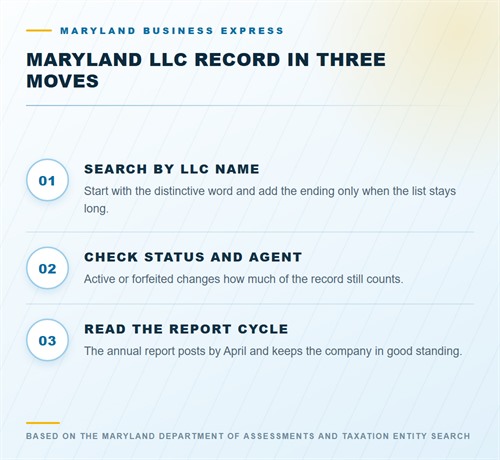
Enter the distinctive portion of the name and omit the ending on the first pass. A query for “Chesapeake” returns companies, corporations, and partnerships that share the word, and that wider list is what shows a near match filed under a slightly different ending. Maryland sets the designation aside when it compares names, so an LLC can sit close to an existing Limited Liability Company without an exact string match. Open the records by identifier rather than by position.
Search by Department ID
A domestic LLC carries a W prefix and a foreign LLC carries a Z. The identifier is issued when the articles are accepted and it stays with the company through every later filing, including a name change. Copy it from the formation receipt or from a certificate of status rather than from a directory site. One wrong digit returns an empty page, and an empty page is easy to misread as a company that does not exist.
Filtering and Comparing Results
Sort a long list by status and then by formation date. An active company with a recent formation date is usually the one trading today, while a forfeited or dissolved record with a similar name belongs to an earlier attempt. Compare the principal office and the resident agent against the address on the invoice or the contract. When two active records share a name, the identifier and the addresses are the fields that separate them. A record with a principal office in another county is a different company even when the name reads the same, and the identifier settles the question faster than a call to either office.
Maryland entity lookup:
https://egov.maryland.gov/BusinessExpress/EntitySearch
What an LLC Record Shows
An LLC record is a charter file, not a business profile. Each entry gives the registered name, the state file number, the current condition, the organization date, the addresses, the agent, and the documents on file. It does not report revenue, employees, customers, or credit history. The file settles three points: whether the company exists, who receives service for it, and what it has filed. Most routine checks turn on those three.
Domestic and Foreign LLCs
A domestic LLC is organized under Maryland law through Articles of Organization filed with the department. A foreign LLC is organized elsewhere and registers to do business in Maryland. The two classes share one index, and the prefix tells them apart before the record opens. The foreign file shows the home jurisdiction and the Maryland registration date, and it carries the same annual report obligation as a domestic company.
Department ID and Formation Date
The Department ID identifies the file, and the formation date marks the day the articles took effect. The two are often confused because both appear near the top of the record. The identifier never changes, while the formation date stays fixed unless a revival or a conversion adds a later date to the history. When a contract refers to the date the company was formed, check that the record agrees before you rely on the reference.
Forming a Maryland LLC
The Articles of Organization are short, and most of the work happens before the form is submitted. The organizer chooses a name that clears the index, states a purpose, gives a Maryland street address for the principal office, and names a resident agent who signs the document. The department accepts the articles and issues the identifier, and the company then exists as a Maryland LLC from the effective date on the filing.
Formation does not produce a tax number, a bank account, or a license. Those come from separate offices, and each one asks for the Department ID or the accepted articles. A new company should keep the receipt with the filed articles, because the receipt carries the date and the identifier that every later form requests. A copy of the articles also belongs in the company’s own records, next to the operating agreement.
Articles of Organization
The form requires the company name, a brief purpose, the principal office address, the resident agent’s name and address, and the signature of the agent. A Maryland address is required for both the office and the agent, and a post office box is refused. The name must carry one of the recognized endings, such as Limited Liability Company, L.L.C., or LLC. An incomplete signature block is a frequent reason a filing is returned without a charter.
Name and Purpose Requirements
The name must be distinguishable from every entity and trade name already on file. A purpose statement of one or two sentences is enough, and a general commercial purpose covers most companies. A name that suggests a regulated activity, such as banking or insurance, may need a consent before the department accepts it. A reservation keeps a cleared name on hold for a limited period while the organizer prepares the articles, and it does not create the company.
Filing Fee and Processing
The articles carry a state filing fee, and the department publishes the amount on its fee list and on the Business Express checkout page. Standard review runs through the normal queue, and expedited handling is available for an additional charge. A card payment in the portal adds a processing percentage. A rejected filing is returned rather than refunded, so check the name, the addresses, and the agent’s signature before submitting.
Members, Managers, and Ownership
Maryland does not publish a member list for an LLC, and the public record does not identify the owners. The articles name the resident agent and the principal office, and the annual report collects tax data, but neither document exposes a membership schedule in the searchable index. A buyer who needs the ownership picture has to request it from the company, from the operating agreement, or from a signed representation in the purchase contract.
What the State Publishes
The public file shows the company name, the identifier, the status, the addresses, and the filing history. It does not show capital contributions, percentages, or manager titles unless a later amendment restates them. A person-name search can return the record when that person is the resident agent, which is a role rather than an ownership interest. Treat such a match as a lead and confirm it with the company.
Operating Agreement
The operating agreement is an internal document, and Maryland does not require it to be filed. It sets out the ownership percentages, the voting rules, the distribution schedule, and the process for admitting or removing a member. Because the state file does not carry it, a buyer or a lender who needs those terms has to ask for the document and a certification that it is current. The absence of a filed agreement is normal, not a defect.
What a Buyer Should Request
A buyer reviewing an LLC should ask for the articles, the current operating agreement, the last two annual report receipts, and a certificate of status. Those four items show how the company was created, who controls it, whether it has kept its reports current, and where it stands today. A seller who cannot produce the receipts is describing a company that may have lapsed. A seller who keeps the file current answers the same request in a day. Check the certificate against the date of the purchase agreement before the file closes.
The Annual Report Cycle
Every Maryland LLC files an annual report with its personal property return, and the deadline falls in April. The report restates the addresses and the agent, confirms the principal office, and reports the personal property the company holds in the state. The filing fee is the same for a domestic and a foreign LLC, and it applies whether or not the company owns property in Maryland or earns income there.
The form is short, and the portal pre-fills much of it from the prior year. A company that changed its address or agent during the year should correct those fields on the report rather than file the old values. The report also drives the department’s revenue estimate for the county, which is why a property schedule that understates equipment can create a later assessment. Keep the confirmation page with the company’s tax file.
Form 1 and the April Date
Form 1 combines the annual report and the business personal property return in a single filing. The due date is April 15, and the department accepts the form online through Business Express. A company that formed partway through the year still files on the same date, because Maryland does not stagger the deadline by formation month. The report is due every year for as long as the company exists.
Fee and Forfeiture
The department sets a report charge each year, and the current amount appears on the form and on the portal. A company that misses the deadline loses its charter rights through forfeiture, and the status field on the record changes. The company can still hold assets and owe money while forfeited, but it cannot carry on business or sue on its contracts. Revival restores the charter once the missing reports and the related charges are paid.
Reinstatement After Forfeiture
A forfeited LLC returns to good standing through a reinstatement filing that follows the missing reports. The department wants the annual reports that were never filed, the fees attached to them, and a reinstatement document with its own charge. The record then shows the revival date beside the earlier forfeiture, so the gap stays visible to anyone who reads the history. Reinstatement does not erase the period when the company was out of standing.
What Revival Requires
The department will not accept a reinstatement on its own. The missing reports have to be filed first, and any balance on the account has to clear before the charter is restored. The company also confirms its current name, address, and agent, because a revival is a good moment to correct stale fields. A paper submission takes longer than an online one, and a company with a closing date should allow for the queue.
Records After Revival
After revival, the status returns to active and the history keeps the forfeiture and the reinstatement as separate entries. A lender reading the file can see that the company lapsed and recovered, which is a different picture from a company that never lapsed. A certificate of status issued after the revival states the current standing, and that document is the one a counterparty usually asks for. The Maryland business registration page covers the filings that surround formation and revival.
Amendments and Agent Changes
An LLC changes its record by filing an amendment or a notice, and each route has its own form and its own charge. A name change, a purpose change, or a change to the principal office runs through an amendment. A change of resident agent uses a shorter notice that identifies the old agent and the new one. Both filings post to the record with a processing date, and both leave the earlier entries in the history.
Name and Address Changes
A name change requires a cleared new name before the amendment is filed, and the old name stays in the history for reference. The company updates its bank accounts, licenses, and contracts after the department accepts the amendment, because the state record does not notify those offices. An address change follows the same pattern, and a company that moves without filing leaves the record pointing at an address it no longer uses.
Resident Agent Notices
The form names the outgoing agent and the incoming one, and the incoming agent signs the filing. The new agent must hold a Maryland street address, and the company cannot act as its own agent. The change takes effect when the department processes the notice, and a resignation by the old agent leaves a gap until a replacement is appointed. That gap is the reason a resignation and a replacement are usually filed together.
Closing an LLC
An LLC ends through Articles of Dissolution or, in some cases, Articles of Cancellation. The filing states that the company has wound up its affairs and distributed its assets, and the department closes the charter when the document is accepted. The record then shows a dissolved status, and the company stops filing annual reports. A company that closes without filing leaves an active record behind, which can mislead a counterparty years later.
Before the dissolution is filed, the company should settle its tax accounts with the Comptroller and close any local license attached to the address. A dissolution with the department does not cancel a sales tax account, and it does not end a lease or a contract. Those obligations follow the owners unless the company has wound them up properly. A short closing checklist keeps the state filing and the private obligations in the same sequence.
Dissolution and Cancellation
Dissolution is the decision to end the company, and cancellation is the filing that removes the registration of a foreign LLC. Both close the file, and both leave the history intact for anyone who needs to trace the entity. Creditors can still pursue a dissolved company for obligations that predate the closure, and the state record is the evidence of when the company stopped existing. The Maryland corporation records page covers the equivalent route for a corporation.
LLC Fees
The department publishes a charge for each LLC document, and the amounts below cover the filings a company is most likely to order. A routine filing waits in the department queue, and a rush request adds a charge. A card payment made in the portal adds a processing percentage at checkout.
| LLC filing | State fee |
|---|---|
| Articles of organization | $100 |
| Articles of amendment | $100 |
| Certificate of correction | $25 |
| Change of resident agent | $25 |
| Change of principal office | $25 |
| Annual report and personal property return | $300 |
| Articles of reinstatement | $100 |
| Certificate of status | $20 |
Frequently Asked Questions
Owners, buyers, and agents asked the questions below. Every answer points to the filing that decides the issue.
Is the Maryland LLC search free?
Yes. The public index charges nothing for a lookup and needs no account. Charges apply to filings, certificates, and copies, and the portal quotes each amount before payment. A search never asks for a card.
Does Maryland publish LLC members?
No. The public file shows the agent and the addresses, not the membership schedule. Ownership comes from the operating agreement or from the company directly, and a buyer should ask for a signed certification.
Can a single person own a Maryland LLC?
Yes. One person can organize the company, hold every membership interest, and serve as the sole manager. The operating agreement should still name the owner and the succession rule. The annual report still falls due.
What happens if the annual report is missed?
The charter is forfeited and the company loses the right to do business. Reinstatement requires the missing reports and the related charges, and the record keeps the lapse in its history. Each skipped year carries its own charge.
Does a foreign LLC file in Maryland?
Yes, once it registers to do business in the state. It then files the same annual report as a domestic company and keeps a Maryland resident agent, even when its office sits in another state.