

Maryland business registration runs through Maryland Business Express, and the filing that creates an entity is a charter document lodged with the State Department of Assessments and Taxation. The department issues a Department ID when the document clears, and that identifier follows the business through every report, amendment, and certificate it will ever need. Registration is the point where a name becomes a legal entity and where the state starts to expect an annual report.
This page sets out the sequence a founder follows: choosing the structure, clearing the name, filing the articles, appointing a resident agent, opening the federal and state tax accounts, and checking the local licenses that sit outside the charter system. It also covers the route a foreign entity takes and the fees the department publishes for each filing.
How to Register a Business in Maryland
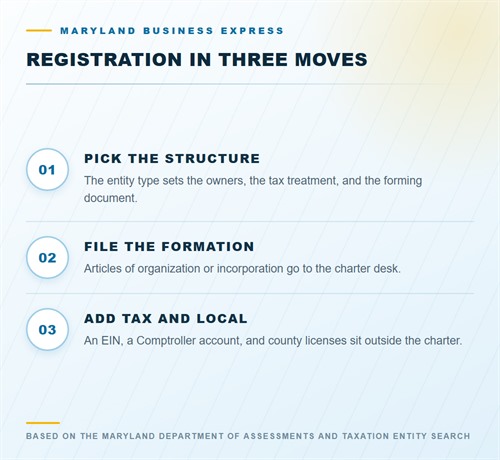
The portal presents the formation filings in one place, and the applicant chooses the entity type before anything else. That choice decides the form, the fee, the report schedule, and the internal paperwork the owners will need later. The Maryland Business Registration route on the home page places the charter beside the tax and local filings. Once the type is set, the portal walks through the name, the addresses, the agent, and the signatures, and it collects payment before the document enters the review queue.
Online and Paper Routes
An online filing through Business Express is the faster route, and the portal validates the name against the index as the applicant types. A paper filing goes to the charter desk in Baltimore and follows the same review, with a longer turnaround. Both routes produce the same charter and the same identifier. The online route adds a card processing percentage, and the paper route avoids that charge at the cost of time.
What the Filing Produces
An accepted filing produces a charter, a Department ID, and a receipt that carries the effective date. The receipt is the document a bank, a landlord, or a tax office will ask for in the first weeks, because the public record can lag the acceptance by a day. Keep the receipt with the filed articles and use the identifier on every later form. The entity exists from the effective date, not from the day the portal accepted payment.
Maryland Business Express:
https://marylandbusinessexpress.maryland.gov/
Choosing an Entity Type
The structure decides who owns the business, how it is taxed, which document creates it, and what the owners must file each year. Maryland offers the limited liability company, the stock corporation, the nonstock corporation, the limited partnership, the limited liability partnership, and the business trust. A sole proprietor can register a trade name without forming an entity at all, which is the lightest route and the one with the least protection.
LLC and Corporation
A limited liability company suits a small group of owners who want flexible management and a single level of tax by default. A corporation suits a business that plans to issue shares, bring in investors, or adopt a formal board structure. The corporation pays an organization and capitalization fee at formation, while the LLC does not. Both file an annual report, and both need a resident agent and a Maryland office address.
Partnerships and Trade Names
A limited partnership has general partners who manage and limited partners who invest, and it files a certificate rather than articles. A limited liability partnership registers a statement and gives every partner limited liability. A trade name is not an entity; it records that an existing business, or a sole proprietor, trades under a different name. Choosing among these forms turns on liability, control, and the way the owners want to be taxed.
Checking the Name Before Filing
The name is the part of the filing most likely to be rejected, and the check costs nothing. Maryland refuses a name that is misleadingly similar to an entity or a trade name already on file, and the comparison ignores the corporate ending. A founder who searches the full proposed name may miss a conflict that a search on the distinctive word would show, and the check itself costs nothing. Run the short query first, then the full name, then a variant with a different ending.
Distinguishability
Two names conflict when a reasonable person would confuse them in the marketplace. A different ending does not cure the conflict, and neither does a small spelling change. A word that describes the business, such as “consulting” or “supply,” carries little weight in the comparison, so the distinctive word is what decides the result. When the index shows a close record, choose a different distinctive word rather than adding a suffix.
Reservation and Trade Names
A name reservation holds a cleared name for a short term while the articles are prepared, and it carries a state charge. The reservation does not create an entity, and it expires if the filing does not follow. A trade name filing is separate and runs for five years, and it cannot be renewed while the underlying entity is forfeited. A founder who plans to trade under a shorter brand should register the trade name after the entity exists.
Filing the Formation Document
The formation document is short enough to complete without counsel in a simple case, and the department publishes a form and a guide for each entity class. The applicant supplies the name, the purpose, the addresses, the agent, and the signatures, and the department checks the document against the statute before it accepts it. A missing field or an unsigned agent block returns the filing without a charter.
Articles of Organization
The LLC files Articles of Organization, which name the company, state a purpose, give the principal office, and identify the resident agent who signs. The name must carry a recognized ending, and the office and agent addresses must be Maryland street addresses. A company that intends to convert from another form later should keep its formation documents and its operating agreement in one file, because the conversion filing refers back to them.
Articles of Incorporation
A stock corporation files Articles of Incorporation that add the share structure: the number of authorized shares and the par value of each. A nonstock corporation files a variant without shares and states its membership and purpose provisions instead. Both name the initial directors and the resident agent, and both require the agent’s signature. The share figures drive the organization and capitalization fee, so a large authorized capital costs more at formation.
Nonstock and Professional Filings
A nonstock corporation that plans to seek federal tax exemption files the same state articles as any other nonstock entity, and the state charter does not grant the exemption. A professional corporation or a professional LLC adds a statement about the licensed service and may need a consent from the regulating board. A filing that names a regulated activity without the consent is held until the document arrives.
Naming a Resident Agent
Every Maryland entity names a resident agent, and the agent receives service of process and notices sent by state agencies. The agent must be a Maryland resident who is at least eighteen, a Maryland corporation, or a Maryland LLC with a street address in the state. The agent signs the formation document, and a filing without that signature is incomplete.
Who Can Serve
An owner can serve as the agent when the owner lives in Maryland and can accept delivery at a physical address. A commercial service can serve for many entities and usually charges an annual fee. A business cannot appoint itself, and a post office box is refused. The Maryland registered agent page covers the field on the public record and the change process.
Signature and Address Rules
The agent’s signature confirms consent to serve, and the address must be a street address where a process server can appear in person. A suite number is acceptable, and a mailbox store is not. When the agent moves, the entity files a notice of change with the department and pays the published charge. A change that is not filed leaves the record pointing at an address the agent no longer uses.
Principal Office and Mailing Address
The principal office is the address the entity declares as its main place of business, and a domestic filing needs a Maryland street address. The mailing address can differ, and many small businesses use a post office box for correspondence while keeping a physical office for the record. The two fields serve different purposes, and a notice sent to the mailing address does not always satisfy a requirement tied to the office.
Maryland Street Address
The office address has to be a real Maryland location, with a number, a street, a city, and a ZIP code on the filing. A home office is acceptable when the owner works there, and it becomes part of the public record. An owner who prefers not to publish a home address can use a commercial office or an agent address, provided the entity has a legitimate Maryland location.
Foreign Entities
A foreign entity registers with a Maryland principal office as well, even when its headquarters stays in another state. The Maryland address is where the state sends notices, and it has to be a physical location. A foreign entity that closes its Maryland office files a change rather than leaving the old address on the record. The registration itself continues until the entity withdraws.
Federal EIN and State Tax Accounts
The charter does not produce a tax number. The federal employer identification number comes from the Internal Revenue Service, and the state tax accounts come from the Comptroller of Maryland. Both are separate from the department that issued the charter, and both are usually needed before the business hires, sells taxable goods, or opens a business bank account.
EIN
The employer identification number is free and can be requested online once the entity has a charter and a responsible party. A single-member LLC that ignores the entity classification is treated as a disregarded entity for federal tax and may use the owner’s Social Security number, while an LLC that elects corporate treatment needs its own number. Banks usually ask for the EIN before opening an account in the company name.
Comptroller Accounts
A business that sells taxable goods or services registers for a sales and use tax account with the Comptroller. A business with employees registers for withholding, and a business that pays a certain level of wages registers for unemployment insurance. Each account has its own application and its own filing schedule. A charter with the department does not create any of them.
Local Licenses and Permits
Maryland does not issue a single general business license that covers every activity. Counties and cities issue trader’s licenses and zoning approvals, and state boards issue occupational credentials for licensed trades and professions. A business can hold a valid charter and still need three separate permissions before it opens its doors, and each one comes from a different office.
The order matters more than the list. A lease usually comes before a trader’s license, a health permit follows the kitchen plan, and a professional credential has to be in hand before the firm advertises the service. A founder who files the charter first and treats the rest as paperwork can lose weeks waiting for an inspection. Build the local list at the same time as the state filing, and confirm the requirements in writing with each office.
County Trader’s Licenses
A trader’s license is issued where the business has a physical location, and the rules vary by county. A retailer, a restaurant, or a contractor with a storefront should check the county office before signing a lease. The license is separate from the state charter and from the sales tax account, and a business that moves to another county may need a new one.
Professional and Trade Credentials
Professions such as medicine, law, accounting, engineering, and electrical work are licensed by state boards, and the credential belongs to the individual as well as to the firm. A home improvement contractor registers with the state, and a food business needs a health permit from the local health department. The charter register does not list these credentials, so a buyer has to check the issuing board.
Registering a Foreign Entity
A business created under another state’s law files a registration in Maryland before it does business there. The application calls for a current home-state certificate, a Maryland office address, and a Maryland agent. Once the documents clear, the department issues the registration, and the entity joins the Maryland report schedule.
Certificate of Good Standing
The home-state certificate proves that the entity exists and is current where it was formed, and it usually has to be recent. A certificate that is several months old may be refused, so order a fresh one close to the filing date. The certificate is not the same as a Maryland certificate of status, which the department issues after the registration is accepted.
Registration Date
The Maryland registration date is separate from the formation date in the home state, and contracts can predate it. A vendor check should compare the two dates when the question is whether the entity was authorized to do business in Maryland at the time of a transaction. A registration that is later withdrawn leaves the home charter intact, and the record shows the closure date.
Processing Times and Follow-Up
Standard review runs on the department’s normal queue, and the portal shows the status of an online filing. Expedited filing shortens the wait for an additional charge, and same-day service carries a much higher one. A filer should check the acknowledgment email, confirm that the Department ID has been issued, and download the accepted document rather than assume that payment equals acceptance. A filing that is returned for a missing signature has to be resubmitted and paid again.
Keep a copy of every submission, including the confirmation screen and the card receipt, because a disputed charge is settled with those documents. If the filing is held for a consent or a clarification, the department sends a notice to the email on the account, and the response window is short. A founder who travels should name a second contact on the account so a hold does not sit unanswered for a week.
Registration Fees
The department publishes a charge for each formation and registration filing, and the table below lists the amounts a new business is most likely to encounter. A rush request adds a charge, and a card payment adds a processing percentage. A rejected document is returned rather than refunded, and the corrected version is charged again at the full rate. A filer who expects a hold should budget for one resubmission rather than assume that the first payment covers the final charter.
| Registration item | State fee |
|---|---|
| Articles of organization, LLC | $100 |
| Articles of incorporation, stock corporation | $100 |
| Organization and capitalization fee | $20 minimum |
| Foreign entity registration | $100 |
| Name reservation | $25 |
| Trade name, five-year term | $25 |
| Certified copy of articles | $20 plus $1 per page |
| Expedited filing | $50 additional |
| Same-day review, online filing | $325 additional |
Frequently Asked Questions
Founders, foreign entities, and advisers sent these questions. The answers name the office or the document that resolves each one.
Do I need a lawyer to register a Maryland business?
No. A simple LLC or corporation can be filed by the owners. A structure with several classes of shares, a conversion, or a regulated activity usually justifies advice before the articles are submitted.
How long does approval take?
An online filing typically clears in a few business days, and a paper filing takes longer. Expedited review shortens the queue for an added charge, and the portal shows the status of the submission.
Can I use a home address?
Yes, for the principal office and for the resident agent, provided it is a Maryland street address and the owner accepts delivery there. The address becomes part of the public file, so an owner who prefers privacy can use a commercial office or an agent address instead. The two fields can share one location when the owner works there.
Do I need an EIN before filing?
No. The charter comes first, and the federal number follows. A bank account usually needs both, and the Comptroller accounts come after the charter as well. The federal number is free and takes minutes to request online.
Does the charter include a business license?
No. Maryland has no general state business license. Local licenses and board credentials are separate from the charter, and each one comes from a different office with its own application. A charter is not a permit.